November 2026
SCRIPTURAL POSITION
I hold this against you, that you abandoned the love you had at first. Rev. 2:4
Age of Persecution – How Did Pagan Influences and Spiritualizing/Allegorizing Scripture Affect the Gap Between Christians and Jews?
SATAN NURTURED THE GERMINATION OF ANTI-HEBRAISM AT SMYRNA
If a sin/rebuke is not repented of, it carries forward until it is addressed sufficiently to remove the accusation and cleanse/free the guilty one(s).
OVERCOMER'S REWARD
... I will give you the crown of life. The one who has ears must now listen to what the Spirit is saying … the one who overcomes cannot be injured by the second death Rev 2:10-11
HISTORICAL BACKGROUND
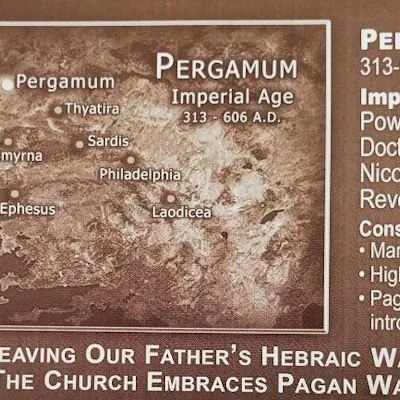
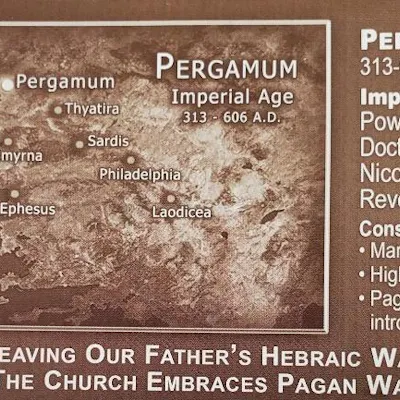
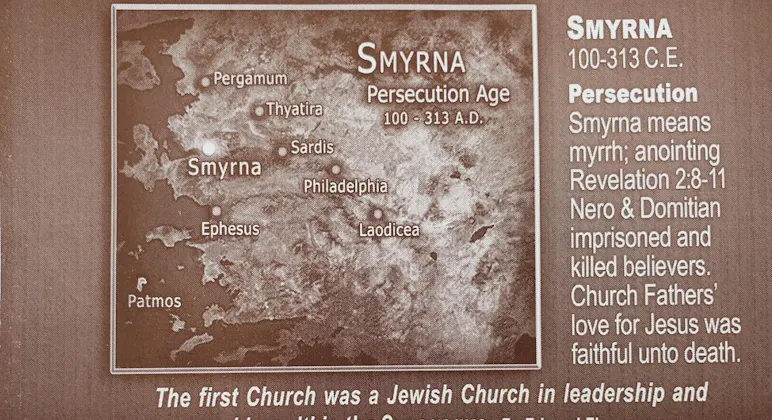
During this time period (100-313 C.E.), paganism was dominant within the region. Christians were relatively safe for a time since they were recognized as part of the government permitted religion of Judaism. As more Gentiles began to hear the Good News of salvation through the Jewish Messiah, they began to fill the synagogues and soon the new Gentile believers began to outnumber the Jewish believers. However, after the first Jewish revolt and the destruction of the Holy Temple in Jerusalem (70 C.E), the Jewish people were scattered and the Christians found themselves standing alone to suffer under Roman persecution, resulting in many martyrs. Nonetheless, the Gentile Church began to grow, although, due to the heavy paganist influence, the new Gentile leadership over the Ekklesia began to spiritualize and allegorize Scripture, further polarizing Christianity and Judaism. Soon Christianity evolved into its own religion, separate from its Hebraic matrix. Christian teaching throughout the second and third centuries reveals a general ridicule and contempt for the Torah and the Jewish people. Just 62 short years later, in 132 C.E. the third Jewish revolt took place by the Jews against the Romans led by the Emperor Hadrian. This is known as the Bar Kokhba Revolt, led by Simon bar Kokhba, who proclaimed himself to be the Messiah. Several intense battles left over 580,000 Jews dead (according to Greek historian Cassius Dio) and many more taken captive. In an attempt to erase any memory of Judea or Ancient Israel, Emperor Hadrian wiped the name off the map and replaced it with Syria Palaestina. (Wikipedia)
For the new Christian faith, Alexandria, Rome and Antioch became the centers of power and influence. The Ekklesia, a movement first based on Torah Teachings birthed through Messiah and His Jewish Apostles, was trumped when the Gentile leaders disconnected from their Hebraic identity, stripped Hebrew from the Biblical text and replaced it with Greek, thus spawning a new Gentile-based religion, "Christianity.”
ANTE-NICENE GENTILE CHURCH FATHERS
- MARCION 85-160 C. E. "Marcion, known to later Christianity as one of the arch heretics of his day was by all counts one of the most significant Christian thinkers and writers of the early centuries. Marcionites offered a highly attractive religion to many pagan converts as it was avowedly Christian with nothing Jewish about it. In fact, everything Jewish was taken out of it. Jews . . . would have difficulty recognizing in the Marcionite religion an offshoot of their own. Not only were Jewish customs rejected, so too were the Jewish Scriptures and the Jewish Elohim. From a historical perspective, it is intriguing that any such religion could claim direct historical continuity with Jesus.” 1
Marcion coined terms like "Old" and “New" Testament. The Merriam-Webster Dictionary defines: Testament: expression of conviction, Covenant: binding promise under seal between two or more parties . . . 1 Bart Ehrman, Lost Christianities, pp. 103-104
Essentially Marcion put away the "Old" Covenant and made the "New” Covenant the primary focus of the Ekklesia. In doing so he created a theological and relational separation of Yeshua and His Apostles from the Father, leaving the appearance that Yeshua is a self-sustained deity opposing the "Old" Covenant. Marcion was the prominent author of Replacement Theology which continues to play a dominant role within most denominations of Christianity today.
- TERTULLAN 160-220 C.E. Tertullian joined other Christian theologians’ anti-Torah teaching, seeking to bring discredit to the Jews. He emphasized blending Greek philosophy, rather than the Hebraic teachings, with Christianity in order to make the Christian religion more acceptable to the pagan Gentiles.
Tertullian, while dabbling in all manner of paganism and spiritism also picked up an ‘anointing’ of the 'Holy Ghost' and demonic inspiration. He compartmentalized the Godhead and coined the word ’Trinity’, one of the most cherished doctrines of Christianity today. Tertulian theology is very akin to the likes of Nimrod, Semiramis and Tammuz who were the trinity of Babylon. He inserted the persons of the Father. Son and Holy Ghost, making him extremely popular among pagan Gentile Christians.
- ORIGEN 185-254 C.E. Origen was a Neo-Platonist philosopher of Alexandria, Egypt. He is credited as the father of the allegorical method of interpretation and made allegory the only way to truly understand the Scriptures. His knowledge of philosophy and theology brought him fame and influence throughout the Roman Empire. His students became leading theologians using the allegorical method (rather than literal interpretation), which helped to establish it as the official method of Christian teaching and laid the foundation for anti-Semitism and antinomianism in Christianity.
Origen stated: "We may thus assert in utter confidence that the Jews will not return to their earlier situation, for they have committed the most abominable of crimes, in forming this conspiracy against the Savior of the human race . . . hence the city where Jesus suffered was necessarily destroyed, the Jewish nation was driven from its country, and another people was called by Elohim to the blessed election".
"In these times it is imperative to understand that these three men [Ignatius, Marcion, Tertullian] are 'pillars of the Church.' These Church founders who are venerated by Christendom, display unfathomable resentment toward the original Netzarim [Notzerim], Jewish followers of Yeshua, not because they happened to be Jews who followed Yeshua, but because they accepted Messiah without ceasing to observe the old law/Torah teaching." Roth, AENT, p.834
If history is a teacher, then we must be wise students of the past so that we are not condemned in the future. It was anonymously quoted once, "History repeats itself because no one was listening the first time." May we be found good listeners, (hearers) and not only listeners, but doers of the Word.
ADONAI’S WORD STANDS FOREVER
Forever, O ADONAI, Your Word is firmly fixed in the heavens.
Your faithfulness endures to all generations; You have established the earth.
and it stands fast By Your appointment they stand this day ...
Ps 119:89-91
ADONAI's Covenants ARE Eternal
I will establish My Covenant between Me and you and your offspring after you throughout their generations for an Everlasting Covenant, to be Elohim to you and to your offspring after you.
Gen 17:7
GENTILE CHURCH FATHERS' THEOLOGY FLAWED
The Scriptures support that the Eternal One's Word, Promises, and Covenants are Eternal/Everlasting, Ps 111:5,9. Of His nine major Covenants, seven were established with the Jewish People, the descendants of Abraham and Sarah, Israel, ADONAI'S firstborn son, Ex 4:22. Despite our Father's warning that His Thoughts and Ways do not align with our thoughts and ways, the theological positions of the Gentile Church Fathers were formed out of conclusions from their natural observation, human ideas, and reasoning. Thus, their writings and teachings are greatly flawed. Gradually they stripped away the Hebraic identity from the Hebraic text replacing it with Greek influence. The scene was set for the next great Gentile leader, Constantine. Without shame or fear of the Eternal One, and by his vested authority, he linked Church and State and established Replacement Theology as Church dogma. ADONAI'S Sabbath, His Calendars, Festivals, and Commandments were replaced by manmade traditions.