January 2027
The Imperial Age - What About Replacement Theology and Supersessionism?
During the Nicene Council it was determined when and how the Christian celebration of Passover would be observed. Easter (also known as Ishtar, the fertility goddess, and Ashtoreth, the goddess of the Sidonians) became the official Christian focus of the resurrection of Messiah on Sunday (sun god), replacing the Hebraic Feast of Passover and First Fruits. Constantine stated: “. . . it appeared in celebration of this most holy feast we should not follow the practice of the Jews, who have impiously defiled their hands with enormous sin, and are, therefore, deservedly afflicted with blindness of soul . . . Let us then have nothing in common with the detestable Jewish crowd; for we have received from our Saviour a different way." 1
"He [Constantine] viewed the Jews as the false Israel which had refused to accept Jesus as the Savior. Laws were made against them." 2 Thus, by the third century, the Ante-Nicene Church Fathers, convinced the Eternal Father was finished with the Jewish people, had established the tenets of "Replacement Theology"/"Supersessionism." Jon Levenson states, "Nowhere does Christianity betray its indebtedness to Judaism more than in its supersessionism."
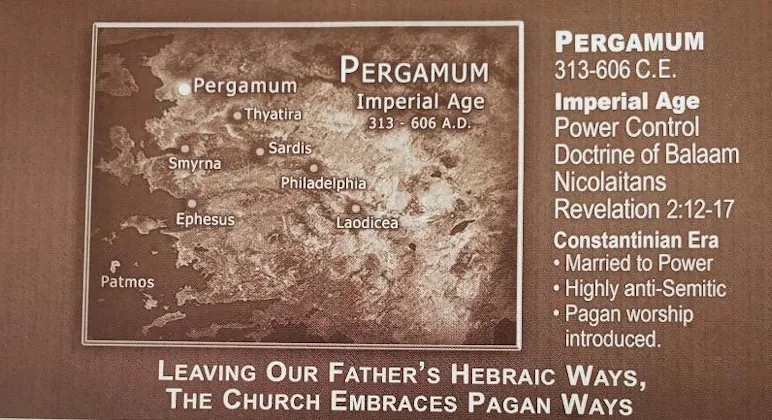
Early in the Pergamum period when the Church and State united, it gave enormous economic, political and judicial power to the Church. Suddenly a remnant of struggling, persecuted believers in the Messiah of Israel became a hierarchical power embracing pagan worship, deities and customs. It was during this time that the Passover observed by the early Jewish believers and Yeshua Himself was officially rejected.
1 Wikipedia "Constantine the Great and Judaism" [Online] Available: https://en.wikipedia.org/wki/Constantine the Great and Judaism (2017 October]
2 Jewish Virtual Library "Ancient Jewish History: Constantine and Helena - Judea Under Christian Rule" [Online| Available: http://wwjowto/urfuallibrryorg Constantine-and-helena-judea-under-Christian-rule.
Consequences of Replacement Theology
(Excerpt from Restoring the Father's Teachings, p. 54)
Nowhere does Christianity betray its indebtedness to Judaism more than in its supersessionism. Jon Levenson
One of the most damaging doctrines to the spiritual health of the Ekklesia / Church is rarely understood and scarcely addressed. Replacement Theology, or Supersessionism, teaches that Christians have replaced the Jews as the Chosen People with whom God will uphold His covenants and bestow His blessings. Like a cancer festering in the body, this ideology has inundated nearly every facet of the Body of Yeshua.
Scholars Identify Key Tenets of Replacement Theology:
- The New Testament replaced the Old Testament
- Christianity replaced Judaism
- Christianity, the "New Israel," replaced Covenant Israel of the Scriptures
- Greek names and ways replaced Hebraic names and ways
- The church replaced the synagogue
- Sunday replaced the Sabbath
- Easter replaced Passover, Unleavened Bread, and Firstfruits Festivals
- Sunday Resurrection replaced Sabbath Resurrection
- Christians replaced the Jews as God's Chosen People
- Rome, Antioch, and Alexandria replaced Jerusalem
- Pope Gregory's calendar replaced the Hebraic calendars
How do we explain that we, the Gentiles, without a hope, a covenant, a promise, Eph 2:12, turned on our Spiritual Parents, the Jewish People, forgetting the debt of love we owe? Only through Yeshua/Jesus could the Gentiles be grafted into the Olive Tree, Rom 11:17-18. Numerous scholars have written on Christianity's breach with the Jewish people. One is David Rausch in Legacy of Hatred. He addresses the relationship of the early Gentile believers and the Jewish community. Rausch agrees with other scholars who view the early Gentile believers as the progeny of Judaism. During the Apostolic period believers were called Notzerim/Nazarenes (followers of the Rabbi from Nazareth). The Romans considered them to be a sect of Judaism.
Drastic changes took place in the Assembly after the destruction of the Temple in 70 C.E. The Jews were scattered, followed by the death of the Jewish Apostles. With the new Gentile leaders bereft of the Apostles' teaching and Biblical text, they were predisposed to deception. The Hebrew scrolls were in synagogues, and the New Testament was not yet written. Satan saw an optimum time. As with Eve, he was able to invade their mind realm, persuading them that the Eternal One was finished with the Jews and the Ekklesia/Church is the "New Israel." Thus, the deception of Replacement Theology was seeded, nourished by centuries-old traditional teaching, and continues today as a well-watered theological root in Christianity's soil. Mk 7:8-9